Class booking for a gym, without the group chat
Small gyms and studios often run class places through a messaging group and a notebook. Why that breaks as the timetable grows, and what self-service booking changes for members and staff.
A lot of small gyms and studios in Greece run their timetable on a Viber or WhatsApp group. The coach posts tomorrow's classes, members reply with their names, someone keeps count, and when a class is full the next person is told it is full. On a small scale it is friendly, it costs nothing, and everyone already has the app.
Then the timetable grows. Two coaches, a morning and an evening block, a Saturday session. The group becomes a scroll of names, and the count becomes a job.
Where the group chat stops working
- Nobody knows how many places are left. The count lives in a message that is buried twenty messages up, or in the coach's head.
- Cancellations do not free the place. A member writes "can't make it" at 7:10 for a 7:30 class. The person who wanted that place stopped reading the group an hour ago.
- The coach becomes the receptionist. Answering "is there room at six?" between sets is not coaching.
- You cannot see the pattern. Which classes are always full, which are half-empty, who has not been in three weeks: all of it is in the chat, and none of it is findable.
What self-service booking changes
We built class booking for KeepFit, a gym that runs up to twelve sessions a day. Members have an account, see the timetable, and book a place themselves. Each session has a capacity, and the number of places left counts down as people book. The site works in Greek and English.
That sounds small. What it changes is who does the work. The member answers their own question ("is there room at six?") by looking. A cancellation puts the place straight back on the timetable, where someone else can take it. The coach coaches.
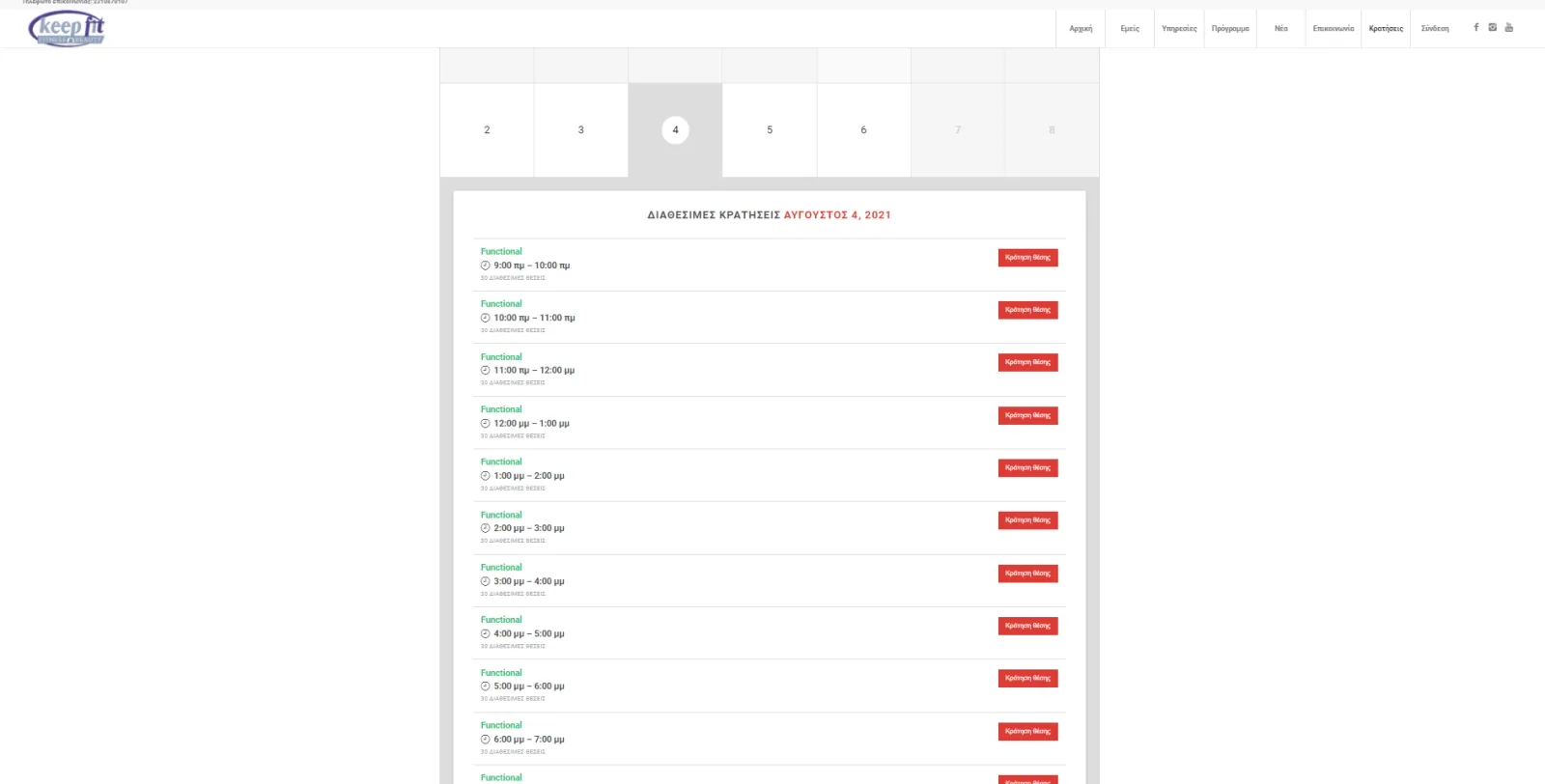 KeepFitClass booking for a gym that runs twelve sessions a day
What I would think about before choosing a tool
There are plenty of ready-made booking apps for gyms, and for many studios one of them is the right answer. Before choosing, it is worth being clear on a few things:
- How members pay. Monthly memberships, class packs, drop-ins, or a mix? The booking tool has to understand your model, or someone will be checking membership status by hand before every class.
- Your cancellation rule. How late can someone cancel, and what happens if they do not show up? Decide the rule first; then check the tool can enforce it without the coach having an awkward conversation.
- Who owns the member list. If you leave the tool one day, can you take your members' details and history with you?
- Language. If you have members who are not Greek — and in cities and tourist areas many gyms do — the booking screen needs to work for them too.
- The monthly fee against the size of your timetable. Per-member pricing that is fine at eighty members can look very different at three hundred.
The honest version
If you run a handful of classes a week and the group chat is not causing arguments, keep it. It is free and your members like it.
If you run several classes a day, have more than one coach, or are losing members you only notice are gone months later, it is worth moving. Whether that means an off-the-shelf app or something built around how your gym actually works is a question we are happy to answer honestly — tell us how your week runs.