Appointment requests or live booking? What suits a private practice
Letting patients pick a slot online sounds obviously better. For many practices it is not. How to choose between a request form and real-time booking, and what each one needs behind it.
When a practice decides to take appointments online, the first idea is almost always the one people know from hairdressers and restaurants: show the free slots, let the patient pick one, done.
For some practices that is exactly right. For many private doctors and dentists, it is the wrong starting point, and it is worth understanding why before paying for it.
Two different things
A request form lets the patient say what they need and when suits them. Someone at the practice reads it, chooses a time, and confirms by phone or message. Nothing is booked until a person agrees.
Live booking shows real availability from the practice's calendar. The patient picks a slot, and it is booked immediately, with a confirmation.
Both are "online appointments". They put very different demands on the practice.
When live booking works well
- Appointments are standard lengths. A check-up, a cleaning, a follow-up: the practice knows in advance how long each takes.
- The calendar is the truth. Every appointment, including those taken by phone, is in the same calendar, immediately. If reception still keeps a paper diary on the side, live booking will double-book within a week.
- Patients know what to ask for. Returning patients booking their regular visit are the ideal case.
When a request form is better
- The length depends on the problem. "My tooth hurts" might be ten minutes or ninety. Letting a patient book a fifteen-minute slot for an extraction wrecks the afternoon.
- The doctor wants to triage. Some cases should be seen today, some can wait, some belong with another specialist.
- The schedule is not fully in one calendar yet.
- New patients need a conversation first, about history, insurance or what to bring.
A sensible middle
Many practices do well with both: live booking for a short list of standard appointment types, for returning patients; a request form for everything else. The website offers both, in plain words: "Book a check-up" and "Tell us what you need".
Whichever you choose, the essentials behind it are the same:
- One calendar that everyone uses, including for phone bookings.
- Confirmations and reminders that go out automatically.
- A clear rule for who answers requests, and how fast. A request form that is read the next afternoon is worse than a phone that is answered.
What we have built on each side
For Dr Dimitris Saridis's practice we built a fast Greek-language site whose job is to get a patient from a search to a phone call or a message with as little friction as possible. Behind the scenes, the dental practice system we built for Saridis Dental Clinic holds patients, the appointment calendar, treatment categories and payments in one place — the single calendar that any kind of online booking would need to rely on.
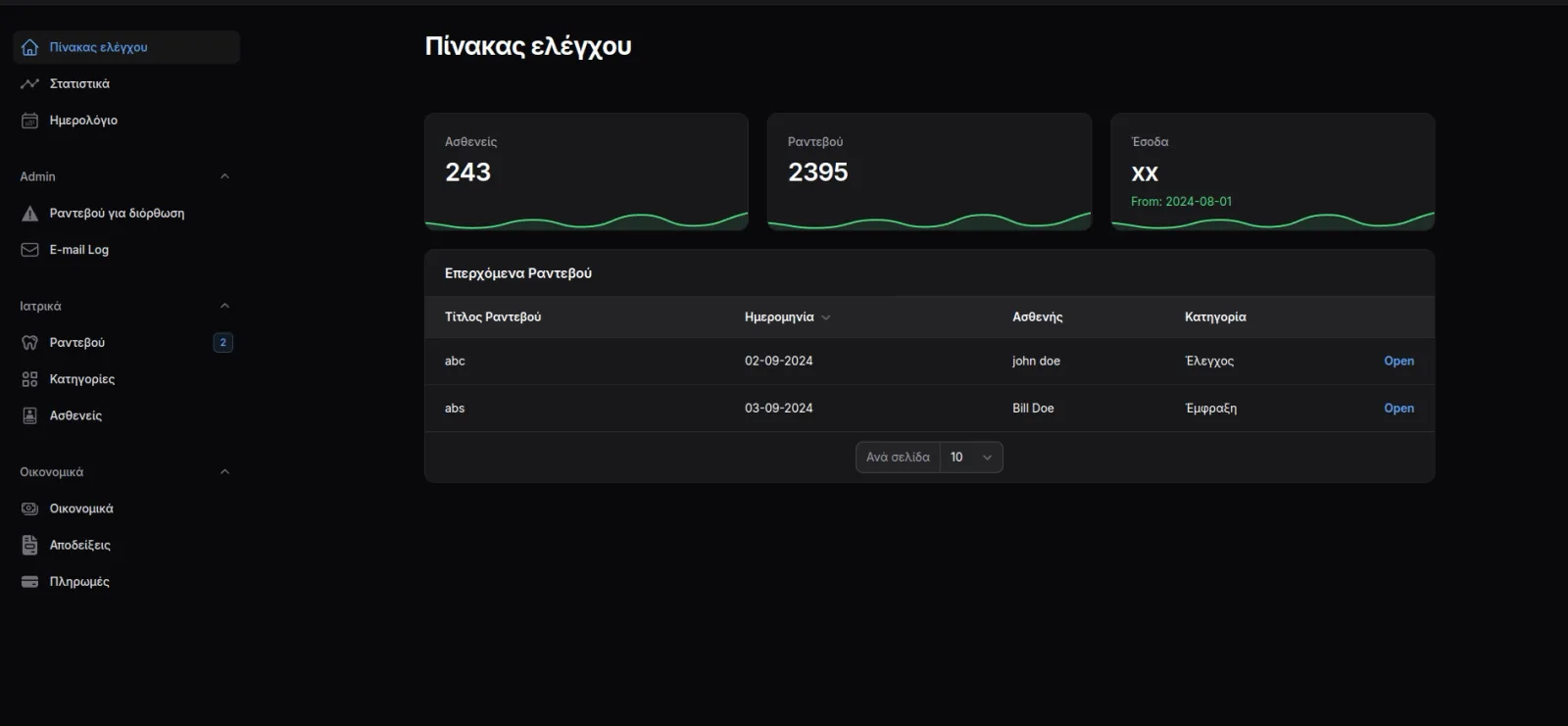 Saridis Dental ClinicA dental practice that stopped keeping two sets of books
The honest version
If your appointment book is still partly on paper, start there. Live booking on top of an unreliable calendar produces double bookings in public. A request form on top of a slow reply produces patients who call someone else. Tell us how appointments are made today, and we will suggest which one to start with.