Accents, final sigma and Greeklish: why search on Greek online shops fails
A customer types 'παπουτσια', 'ΠΑΠΟΥΤΣΙΑ' or 'papoutsia' and your shop finds nothing. Greek text breaks search in ways English never does. What goes wrong and how a shop should handle it.
Open almost any small Greek online shop, and try three searches for the same thing: παπούτσια, παπουτσια and papoutsia. On many shops, only the first one — with the accent in exactly the right place — returns results. The other two return an empty page that says "no products found".
Every one of those empty pages is a customer who wanted to buy something you sell, and was told you do not have it.
For readers who do not write Greek: this is not an obscure edge case. It is how a large share of people type Greek on a phone.
How Greek text trips search up
Accents (tonos). Greek words carry an accent mark, and many people skip it when typing quickly, especially on a phone. To a naive search, παπουτσια and παπούτσια are different strings.
Capitals. Greek capitals are normally written without accents. A product called ΒΑΠΤΙΣΤΙΚΟ ΦΟΡΕΜΑ in the catalogue and a customer typing βαπτιστικό do not match unless the search removes accents and case on both sides.
Final sigma. Greek has two lowercase sigmas: σ inside a word and ς at the end. Someone searching for part of a word — λαμπάδ — or a shop whose data was entered inconsistently can miss matches because ς and σ are treated as different letters.
Greeklish. Many people, especially younger ones and Greeks abroad, type Greek words with Latin letters: papoutsia, vaptistika, lampades. And there is no single spelling: papoutsia, papoytsia and papoutsya are all in use.
Mixed catalogues. Brand and model names are often in Latin letters, while categories and descriptions are in Greek. A good search has to match both.
What a shop's search should do
- Normalise before comparing. Lowercase everything, remove accents and diacritics, and treat ς and σ as the same letter — on the product data and on what the customer types.
- Transliterate Greeklish into Greek (and match the common alternative spellings) before searching.
- Match word beginnings, so a partial word still finds results while the customer is typing.
- Search the right fields: title, category, tags and SKU, not only the product name.
- Never show a bare "no results". Suggest categories, popular products or a similar spelling.
- Read your own search log. The searches that returned nothing are a free, exact list of what customers wanted and could not find.
The same problem outside search
Greek text breaks things beyond the search box. When we built the ASETH league's registration system, rosters arrived as spreadsheets from every team, and names in Greek had to be imported and matched cleanly alongside dates typed in several formats. Data entered by many different people is always inconsistent; the software has to be the one that is consistent.
On a shop like Paidiko Rantevou, where customers look for βαπτιστικά or πακέτα βάπτισης in whichever way they type them, that consistency is the difference between a sale and an empty page.
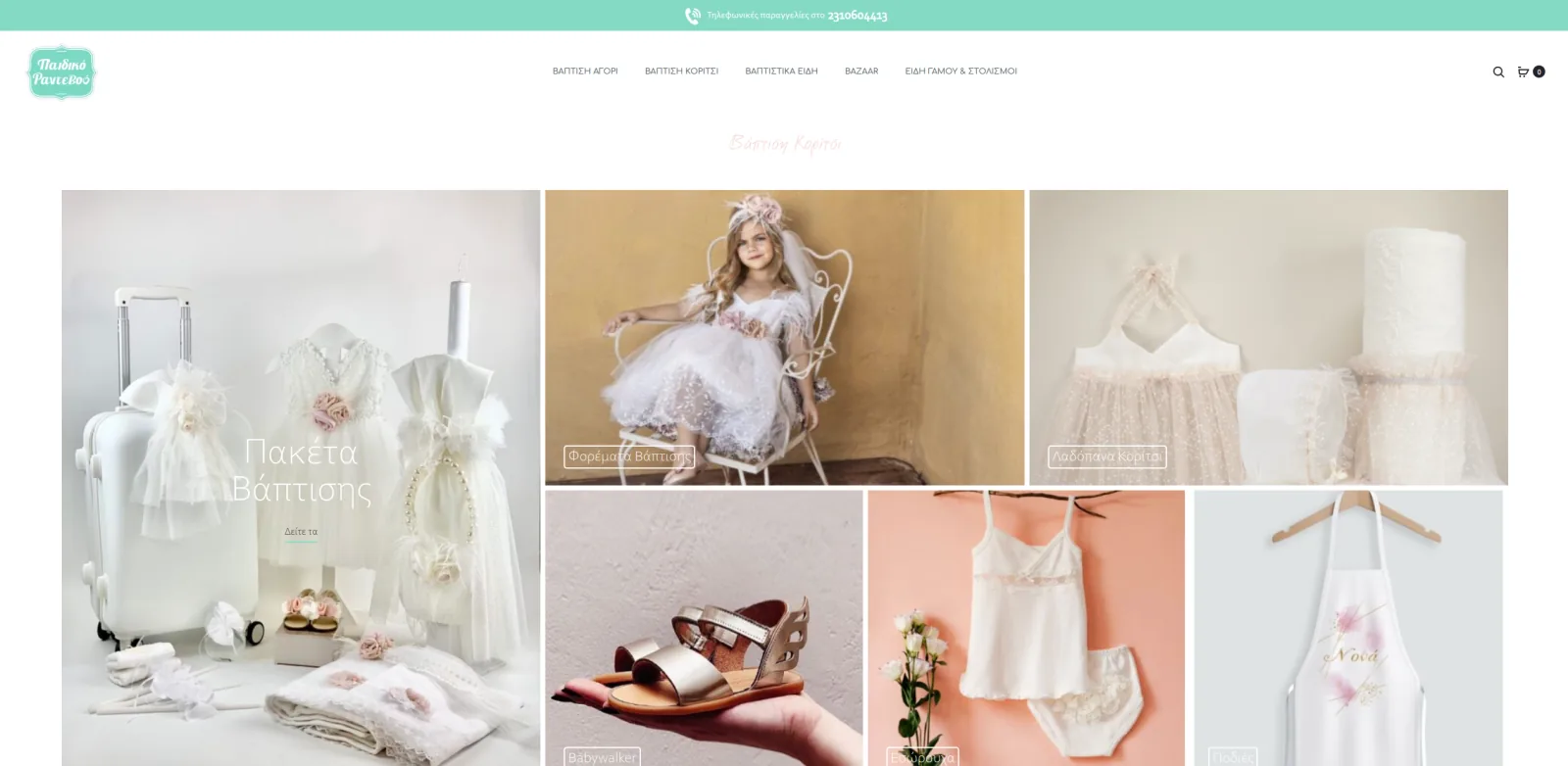 Paidiko RantevouA christening shop that survives its own season
A test you can do in two minutes
Take your three best-selling products. Search for each one on your own shop in four ways: with accents, without accents, in capitals, and in Greeklish. If any of those twelve searches comes back empty, your search is losing sales every day. Send us the results and we will tell you what it would take to fix.