Greek first or English first? Building a bilingual site for a Greek business
Holiday suites, builders and architects in Greece sell to Greeks and to foreigners at once. Why translating the Greek page is not enough, and how to set up two languages that both work.
A lot of Greek businesses have two audiences without ever deciding to. Holiday suites in Halkidiki are booked by Greek families from Thessaloniki and by visitors from the Balkans, Germany and further afield. A construction studio sells apartments to local buyers and to Greeks living abroad. An architecture practice wins Greek clients and foreign ones who own property here.
So the site ends up bilingual. Usually that means the Greek site was written first, and someone translated it — or ran it through a translation tool — and put a flag in the corner.
That is better than nothing. It is rarely good.
Why translation is not enough
The two readers are not asking the same questions.
- A Greek family booking suites in Halkidiki wants to know how far the sea is, whether there is parking, and whether the price includes breakfast. They know where Nea Moudania is.
- A visitor from abroad needs all of that, plus how to get there from the airport, whether card payment works, what "a few minutes from the centre" means on foot, and a phone number written with +30 in front.
A translated page answers the first reader's questions in the second reader's language. The questions that only the second reader has are simply missing.
What a bilingual site needs
- Separate addresses for each language.
/el/suitesand/suites, not a switch that changes text on the same address. Search engines need a distinct page to show in each language, and a tag that says the two are versions of each other. - Pages written for each reader. Same facts, different emphasis. The Greek page can be shorter where local knowledge is assumed; the English page longer where it is not.
- The same structure. Every page in one language has its counterpart in the other. Half-translated sites, where the English version stops after the homepage, lose the visitor at exactly the moment they got interested.
- Forms that work in both. A booking request in English that sends an email in Greek to the owner is fine; a form whose error messages are only in Greek is not.
- A deliberate default. Which language does someone see first? That depends on who pays. For holiday suites taking foreign bookings, English may lead. For a builder selling mainly to local buyers, Greek should.
Examples from our own work
The Olea Suites website is English and Greek throughout, with a page per suite describing size, capacity and amenities, and a booking request form in both. The 3kconstruction site presents a Thessaloniki studio's available homes in both languages, and the TazLab site does the same for an architecture practice's projects.
This site is built the same way: English at the plain addresses, Greek under
/el, and every page written in both — including this article.
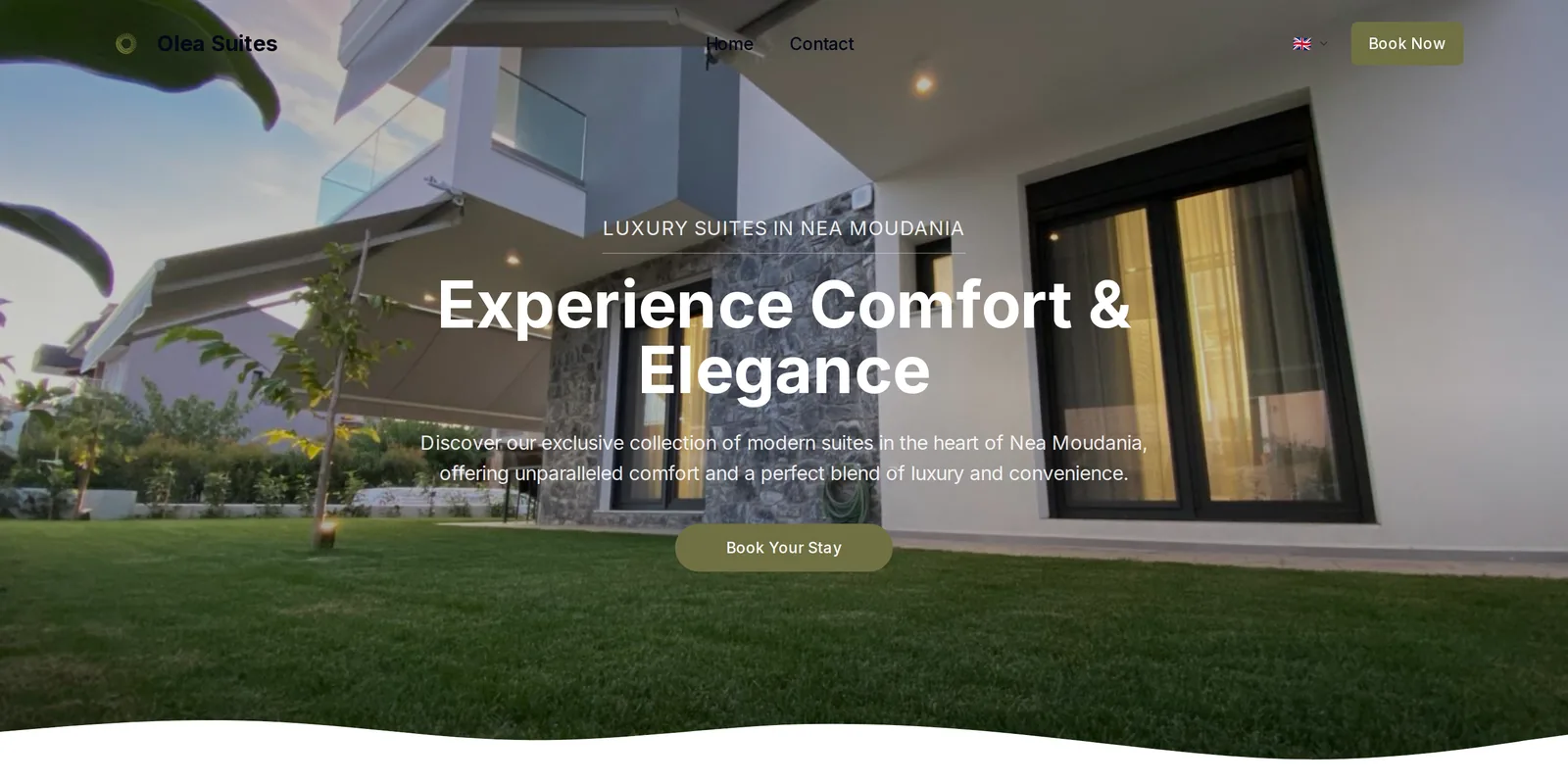 Olea SuitesHoliday suites that take booking requests on their own site, in two languages
The honest version
If nearly all your customers are Greek, a second language may not be worth it. A good Greek site will do more for you than a mediocre bilingual one. If a real share of your customers read English, the second language deserves the same care as the first. Tell us who your customers are, and we can tell you which language should lead.