When a practice's appointment book lives in one person's head
Small practices run on a diary, a spreadsheet and whoever answers the phone. What that costs when that person is off sick, and what a practice needs instead.
A small dental or medical practice usually has one person who is the appointment book. They know that Mrs K. only comes on Tuesdays, that the patient at eleven always runs late, that the Friday slot is not really free because the doctor leaves early. The paper diary says one thing. They know the real version.
It works beautifully, right up to the week they are off.
I think this is the most underestimated risk in a private practice, because it never looks like a risk. It looks like a very good receptionist.
What actually breaks
When the book lives in someone's head, a few things go wrong in a predictable order:
- Double bookings. The diary shows a free slot that was promised on the phone and never written down.
- Patients who do not show up. Nobody reminded them, because the reminder was a phone call someone made when they had a spare minute, and this week nobody had one.
- Payments nobody can reconcile. The treatment is in the diary, the receipt is in a book, the payment is in a spreadsheet, and the three only agree when the same person wrote all of them.
- A patient history that has to be asked for. "When was the last cleaning?" becomes a search through paper instead of a glance at a screen.
None of these is dramatic. Together they are an afternoon a week, and a practice that feels busier than it is.
Two books is one too many
At Saridis Dental Clinic the practice was keeping two sets of records: a paper diary for appointments and a spreadsheet for patients and payments. Neither was wrong. The problem was that they were two, and keeping them in step was a job in itself.
We replaced both with one system that holds patients, appointments, treatment categories, receipts and payments together. Today it holds 243 patients and 2,395 recorded appointments. The number I care about is not those, though. It is that there is one place to look, and anyone at the practice can look there.
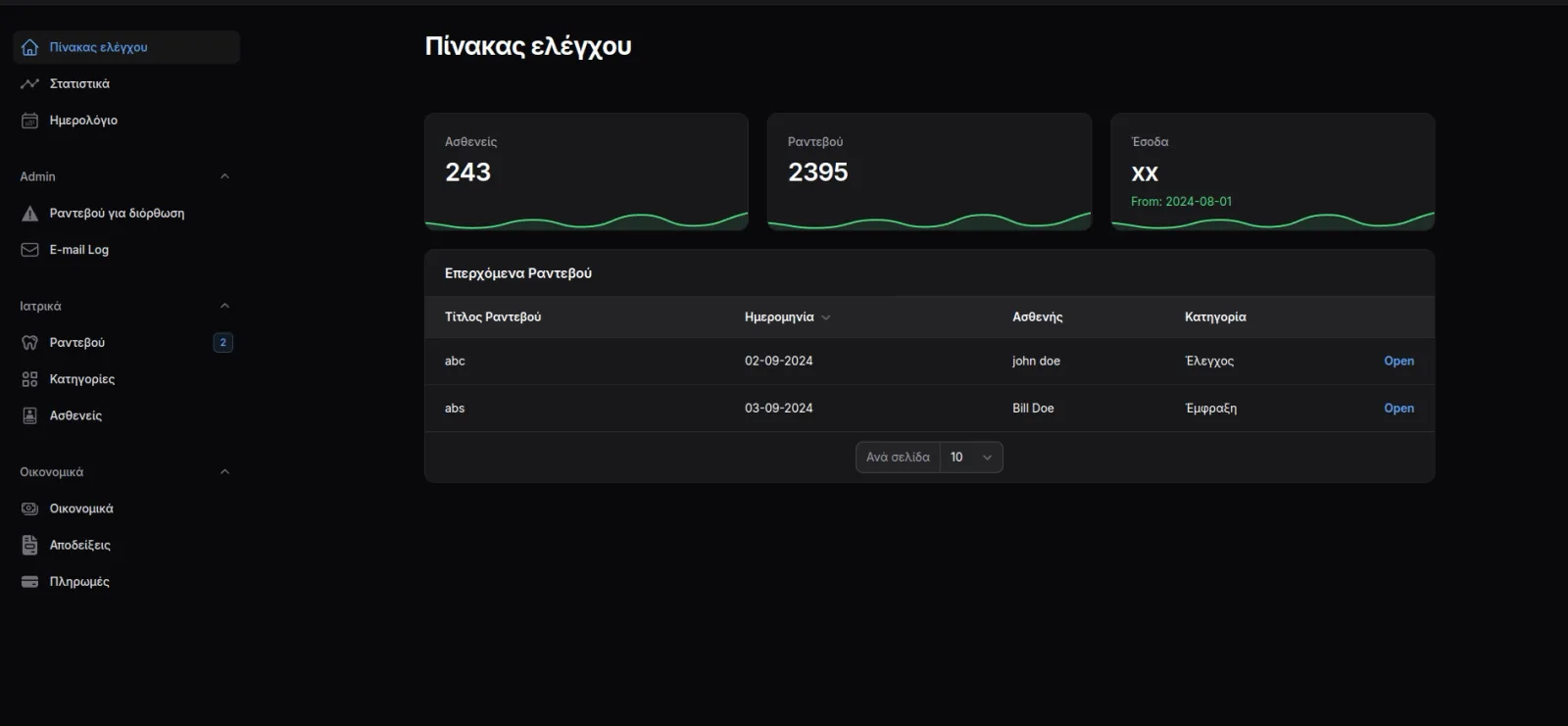 Saridis Dental ClinicA dental practice that stopped keeping two sets of books
What a practice needs, in order
Not every practice needs custom software. Here is what I would look at, and roughly in this order:
- One calendar that everyone uses. Even a shared online calendar is better than a paper diary plus memory, as long as everyone writes in it and nobody keeps a private version.
- Reminders that do not depend on a free minute. An automatic message the day before an appointment is the cheapest no-show fix there is.
- The payment next to the appointment. When a treatment and its payment sit on the same record, "has this been paid?" stops being a question.
- A patient record you can open in seconds. History, treatments, upcoming appointments, on one screen.
The first two can be done with off-the-shelf tools. The last two are where general tools start to strain, especially when a practice has its own treatment categories, several chairs or rooms, or more than one doctor.
For larger setups the same logic scales. The KlinikiMitera clinic system covers patients, doctors, procedure types, the anaesthetist rota, suppliers, stock and cash flow, because in a clinic all of those collide in the same calendar.
A note on patient data
Health records are the most sensitive data a small business holds. Whatever you move to — a shared calendar, an app, a system built for you — ask where the data is stored, who can see it, and how it is backed up, before you ask what it costs. Check with your adviser what the rules require of you.
Where to start
Spend one week writing down every time someone at the practice had to ask someone else a question the diary should have answered. That list is your case for change, or your proof that the current way is fine. If it is the first, talk to us.