The withdrawal button: what changes for online shops from 19 June
From tomorrow, EU online shops must let customers withdraw from a purchase with a clearly labelled button. What it has to do, who is exempt, and what to check on your own shop tonight.
From 19 June 2026, anyone selling to consumers online in the EU has to offer something new: a clearly visible way to withdraw from a contract, online, without writing an email or hunting for a form. The press has started calling it the "withdrawal button". It comes from an EU directive from 2023, and Greece, like every member state, applies it.
This is not a new right. Customers in the EU have long been able to withdraw from most online purchases within 14 days. What is new is that exercising that right now has to be as easy as the purchase was.
I am writing this the day before it applies, because rules like this tend to reach small shops through a customer's complaint rather than a newsletter.
What the button has to do
From the legal summaries we have read (links below), the essentials are:
- It has to be easy to find and clearly labelled — something along the lines of "withdraw from contract here", not hidden in the terms page.
- It works in two steps. The customer gives the basic details — name, the order, how they will be contacted — and then confirms.
- They get an acknowledgement, with the date and time, on a durable medium such as an email, without delay.
The button does not change what happens next — how the goods come back, who pays for return shipping, when the refund is due. Those rules are the same as before.
Who does not need it
The button is needed where a right of withdrawal exists. EU consumer law has long excluded some kinds of purchase from that right, including:
- Goods made to the customer's specification or clearly personalised. An embroidered name on a christening outfit is a good example.
- Goods that spoil quickly, and sealed hygiene products once unsealed.
- Accommodation, car rental, catering and leisure services booked for a specific date or period. This matters for a lot of Greek tourism businesses: a room for 12–15 August or a dive on a set morning is generally not covered by the 14-day withdrawal right. Your own cancellation policy still applies — and still has to be clear.
If a shop sells both kinds — standard items and personalised ones — the button is still needed for the standard ones.
What to check on your own shop
- Is there a visible withdrawal function? Not a paragraph in the terms, not "email us". On WooCommerce, check whether your version or an established plugin provides one, and test it.
- Does it send the acknowledgement? Place a test order, withdraw, and confirm the email arrives with the date and time.
- Does the shop know which products are excluded? Personalised items should say so on the product page, before purchase.
- Does someone get told? A withdrawal that lands in an inbox nobody reads is a refund deadline you will miss.
For a christening shop like Paidiko Rantevou, the interesting part is the split: ready-made clothes can be withdrawn, personalised items generally cannot, and the shop has to make that clear before the customer pays.
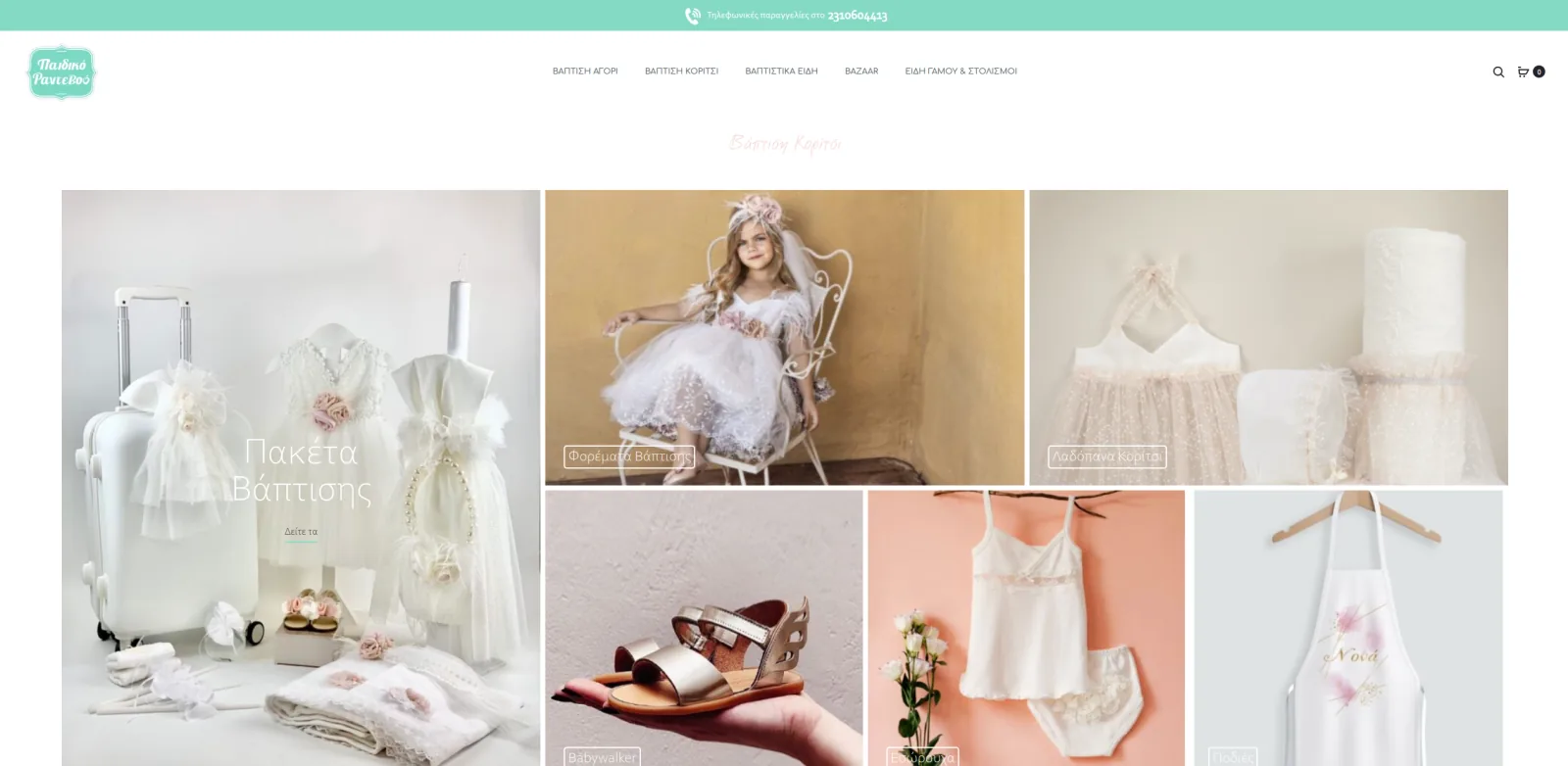 Paidiko RantevouA christening shop that survives its own season
The honest version
This is a legal requirement, and I am not a lawyer. The sources below are the summaries we read; the details of how Greek law applies it, and what your particular products fall under, are a question for your lawyer or accountant.
What we can do is the technical part: add the function, make the emails reliable, and mark the excluded products. If your shop is on WordPress or WooCommerce and you are not sure where you stand, send us the link.