What patients check before they call a private practice
Before booking a dentist or a doctor, people look for a handful of plain facts. Most practice websites make them hunt. What to put first, and what to leave out.
Choosing a dentist or a private doctor is not like choosing a restaurant. People are often anxious, sometimes in pain, and rarely in the mood to browse. They search, open two or three practices, and look for a few plain answers. The practice that gives them those answers fastest usually gets the call.
What strikes me about most practice websites is that they are written for other doctors. Long lists of qualifications, a paragraph about philosophy of care, a stock photo of a smiling family. The address is in the footer. The phone number is an image you cannot tap.
What a patient is actually looking for
In roughly the order people look for them:
- Can I get there? The address, the area, a map, and — in a Greek city — whether there is anywhere to park.
- When are you open? Actual hours, including whether you see patients in the evening or on Saturday.
- Do you do the thing I need? Not a list of every procedure, but plain words: "cleaning", "implants", "a child's first visit".
- How do I book? A phone number you can tap, and if you take requests online, a form that works on a phone.
- Who will I see? A real photo and a name. People want to recognise the person before they sit in the chair.
Everything else is secondary. Qualifications matter, but a patient reads them after they have decided you are close, open and doing what they need.
Speed is part of the first impression
A practice site is usually opened on a phone, often on mobile data, sometimes in a waiting room somewhere else. If it takes several seconds to show anything, a real share of people go back to the search results.
When we built Dr Dimitris Saridis's practice site, speed was a requirement from the start. It is a Greek-language site, and on the day it launched it scored 96 for performance, 92 for accessibility, and 100 for both best practices and SEO in Google's PageSpeed test on desktop. None of that is what a patient sees. What they see is a page that is simply there when they tap.
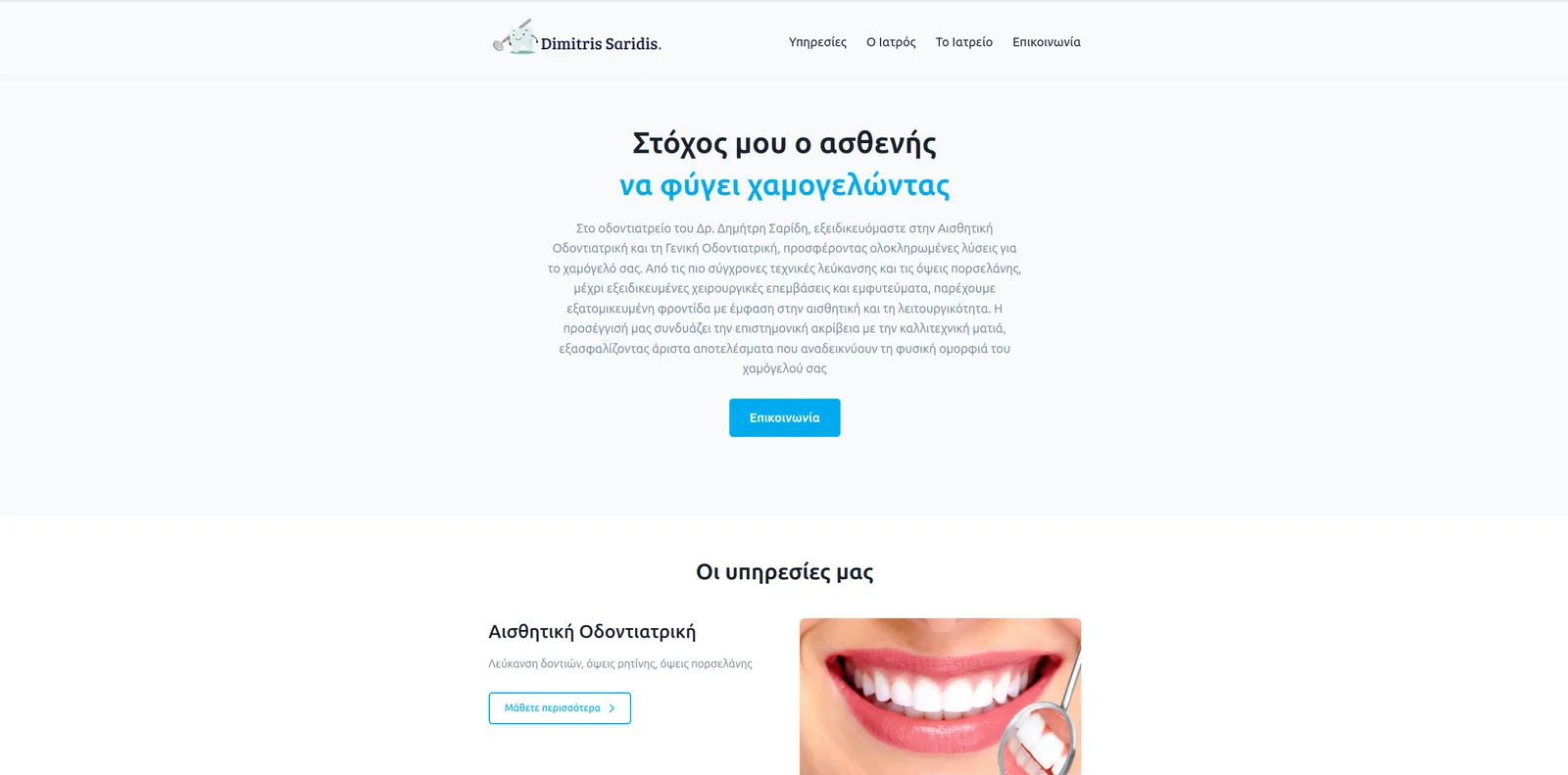 Dr Dimitris SaridisA practice website that loads before the waiting room does
Search and AI assistants ask the same questions
The plain facts that help a patient are exactly what Google and AI assistants need to recommend you. When someone asks "a dentist near Kalamaria open on Saturday", the answer comes from sources that state the area, the hours and the services clearly. Your Google Business Profile, your own site and any directory listings should all say the same thing. That is the whole idea behind our AI visibility work: say the plain facts clearly, and say them the same way everywhere.
A note on what you may publish
Doctors and dentists in Greece work under a code of ethics that limits how they can advertise. Before-and-after photos, testimonials and claims about results are areas to check with your medical or dental association before they go on a website. Plain facts — who you are, where, when and what you treat — are rarely the problem.
A quick test
Open your own site on your phone, on mobile data, and time how long it takes to find the address, the hours and a phone number you can tap. If any of those takes more than a few seconds, that is the first fix. If you would like help with it, get in touch.