The digital work card reaches salons and clinics. The hard part is the rota
Health, beauty and personal care joined Greece's digital work card pilot in June, with penalties from 12 October. Clocking in is easy. Keeping the declared rota true to the day is not.
On 2 June 2026, Greece's Ministry of Labour extended the psifiaki karta ergasias — the digital work card — to another set of sectors. The first group includes health and social care services, beauty and personal care such as hair salons and beauty centres, telecommunications, employment support and building services. The pilot runs until 11 October. According to the ministerial decision as summarised by EY, administrative penalties apply from 12 October.
A second group — consulting and advertising, repairs, logistics, water management and gaming — has a pilot from 29 June to 15 November.
For readers new to it: the digital work card records, in real time, when each employee starts and finishes work, and it is checked against the working schedule the employer has declared in ERGANI, the Labour Ministry's system. Where the two do not match, that is what an inspector sees.
Why appointment businesses feel it differently
In a supermarket, shifts are planned a week ahead and mostly stay that way. A salon or a private practice runs on appointments, and appointments move:
- A client books a late colour on Friday, and a stylist stays an hour past the declared finish.
- A procedure runs long, and the nurse and the assistant leave late.
- A cancellation opens a gap, and someone goes home early, or comes in late the next day to cover.
- Part-time staff cover different days from week to week, depending on the book.
Each of these is a normal day. Each is also a moment where the declared schedule and the actual clock-in and clock-out no longer match, unless someone updates the schedule in time.
The rota and the appointment book are the same problem
The underlying issue is that in most small salons and practices, the appointment book and the staff rota are two separate things. One is in the booking app or the diary. The other is in a spreadsheet, a message group, or the owner's head. The work card forces them to agree, and it does so in real time.
In a clinic this is already familiar. The KlinikiMitera system we built keeps the anaesthetist rota in the same place as appointments and procedure types, precisely because a theatre schedule and a staff rota that live in different places will eventually contradict each other — and in a clinic, that is not just an administrative problem.
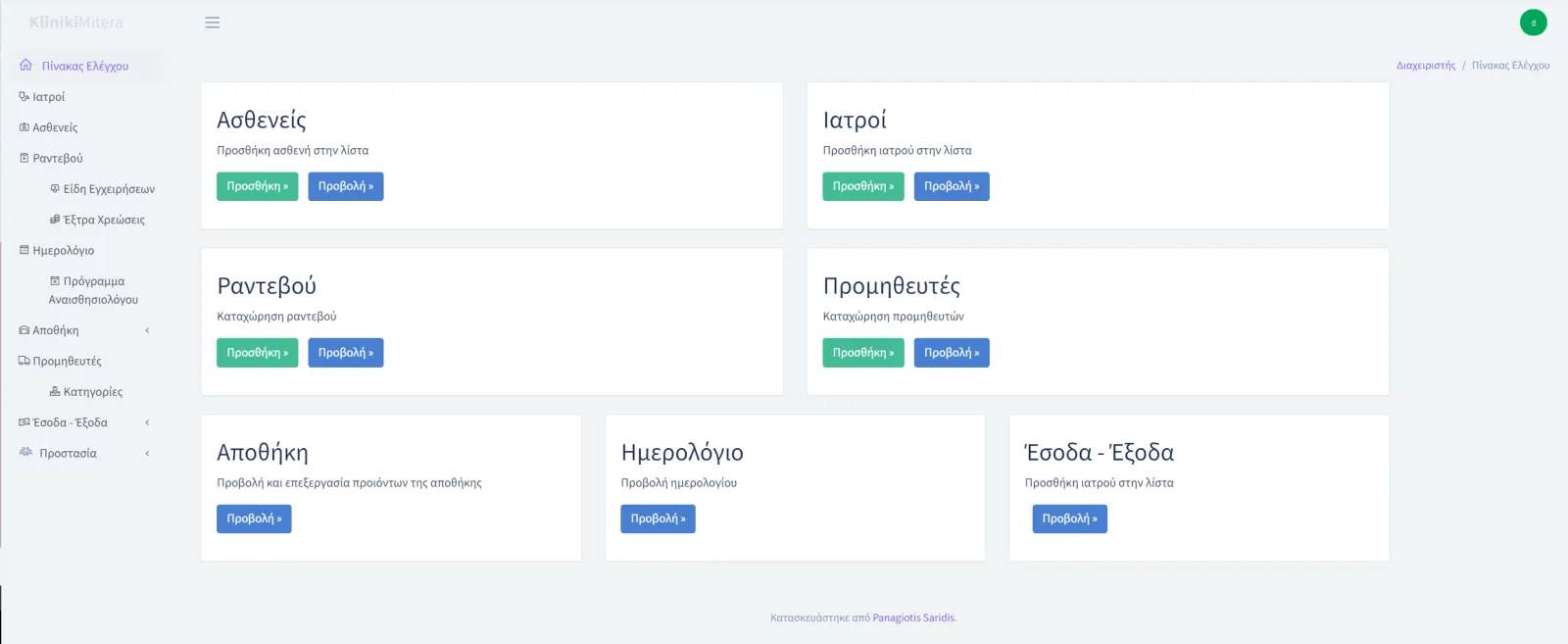 KlinikiMiteraClinic administration, from rota to stock room
What I would do before October
- Write down how the rota is really made. Who decides it, when, where it is kept, and how often it changes after it is published.
- Count last month's changes. How many times did someone finish late, start early or swap a day? That number tells you how much updating the work card will need.
- Decide who updates the schedule, and when. A rule that says "the manager updates ERGANI before the change happens" is only real if the manager knows about the change in time.
- Ask your accountant or payroll provider exactly how schedule changes and overtime must be declared in your case. The rules have details, and they know them.
- Look at where appointments and shifts could meet. If your booking system already knows who is working with which client and when, the rota should not be a second, separate document.
The honest version
A two-chair salon with a stable team will adapt with a phone app and a bit of discipline. A clinic or a larger salon with part-timers, long procedures and a busy book will find October harder, because the rota changes more than anyone has had to write down before.
The legal side belongs to your accountant. If the operational side — keeping the book and the rota telling the same story — is the hard part for you, let's talk about it.