Who sent this customer? Paying hotels and agencies what they are owed
Activity operators live on referrals from hotel receptions and travel agencies. When commissions are tracked from memory, partners notice. How to keep it exact without it becoming a job.
On a Greek island, a lot of an activity business's customers do not find it on Google. They find it at a hotel reception desk. The receptionist recommends a dive centre, a boat trip or a jeep safari, makes a call, and the customer arrives the next morning. Travel agencies, villa managers and concierge services do the same.
Every one of those referrals is owed something. And in a lot of businesses, what is owed lives in a notebook, a spreadsheet updated at the end of the week, or the owner's memory.
Why this matters more than it looks
Partners who send customers pay close attention to whether they get paid, and whether they get paid correctly. It is their income too. When the amount at the end of the month is lower than they expected, the conversation is not about money. It is about trust, and a reception desk that no longer trusts you has plenty of other operators to recommend.
The things that go wrong are predictable:
- The referral is not recorded at booking time. "Who sent you?" gets asked at the counter, in the rush, and the answer is forgotten.
- Rates differ by partner and by service, and whoever does the sums at the end of the month has to remember which rate applies.
- Cancellations and no-shows complicate it. Is commission owed on a booking that never turned up? The rule exists; applying it by hand is where mistakes happen.
- Statements take hours, so they are sent late, so partners chase.
What we built for a dive centre
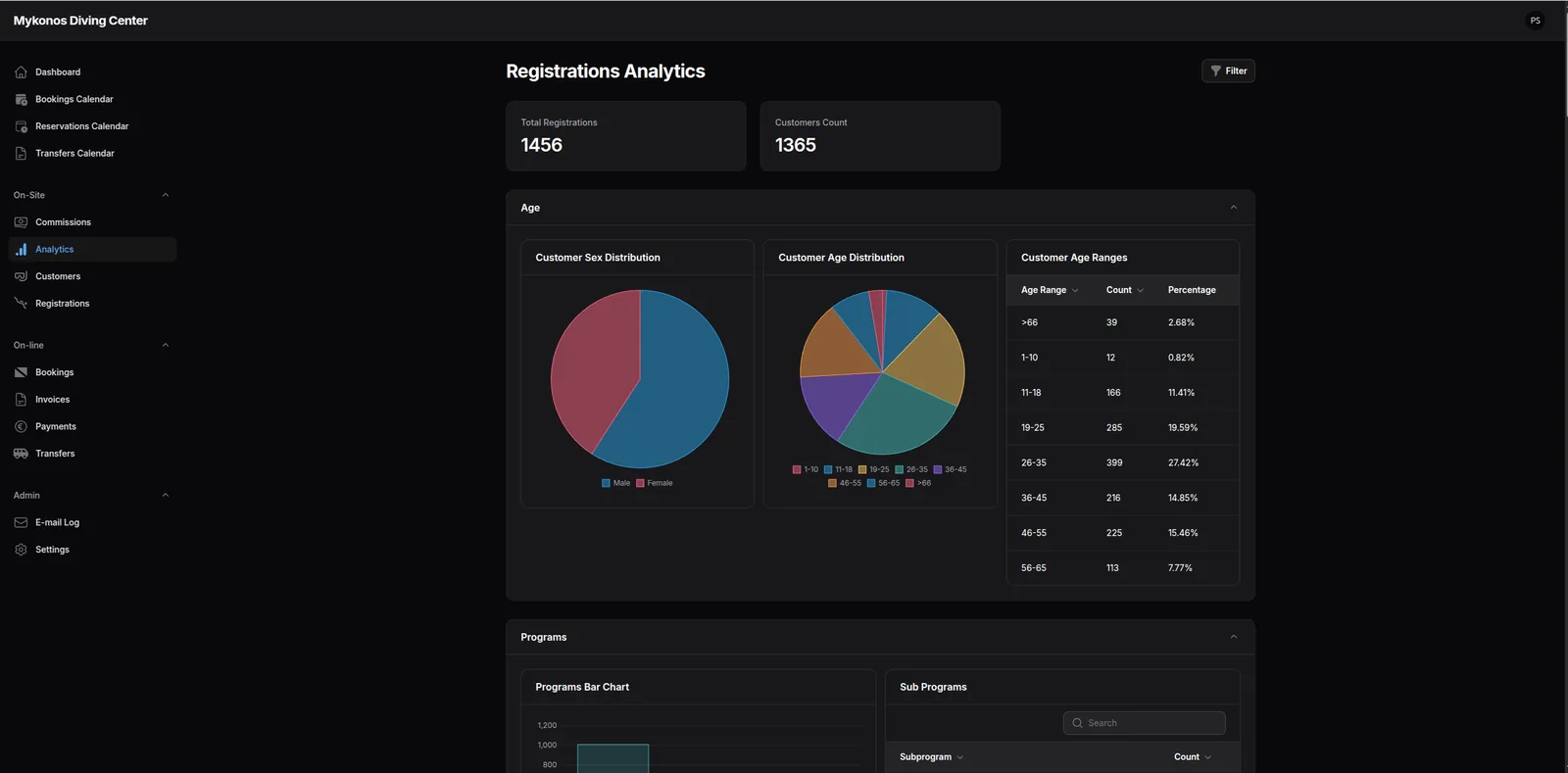
At Mykonos Diving Center, hotels and agencies send customers, and before the system the relationships were running on memory. In the reservation system we built, the partner is part of the booking itself. Commission is calculated automatically from rates set per partner and per service, so nobody has to remember that, say, one hotel gets a different rate on certification courses than on single dives.
Partner referrals rose 42% after the system went live. I would not claim the software sent those customers. But partners who are paid correctly, without chasing, are partners who keep recommending you.
 Mykonos Diving CenterReservations, payments and partner commissions in one system
What you can do before you need software
- Make "who sent you?" a required field. Whether it is a booking form, a paper sheet or a system, the referral should be captured when the booking is made, not reconstructed later.
- Write the rates down in one table. Partner, service, rate. If it is not written down, it is not agreed.
- Decide the rule for cancellations and no-shows, tell partners, and apply it the same way every time.
- Send a statement on a fixed day. Even a simple one. Regularity builds more trust than generosity.
The honest version
If you work with three partners at one flat rate, a spreadsheet does the job. If you work with dozens, at different rates per service, across a busy season, the sums are where the mistakes live — talk to us about getting them out of anyone's head.